



Everything business leaders need to know about staff augmentation services — how IT staff augmentation works, types, costs, benefits, and how it compares to outsourcing and permanent hiring.
Table of Contents
- What Is Staff Augmentation?
- Why Companies Use Staff Augmentation
- 5 Types of Staff Augmentation
- Staff Augmentation vs Outsourcing vs Hiring
- How Staff Augmentation Works: 8 Steps
- Staff Augmentation Mistakes to Avoid
- IT & Industry-Specific Applications
- Future of Staff Augmentation + AI
- Staff Augmentation FAQ
What Is Staff Augmentation? (Definition & Meaning)
Staff augmentation is a flexible workforce strategy where companies hire external talent on a temporary basis to fill skill gaps, scale delivery capacity, or complete time-bound projects — while retaining full control over the work. Unlike outsourcing, augmented staff integrate directly into your existing team, follow your internal processes, and report to your managers.
The staff augmentation meaning is often confused with outsourcing or managed services. What makes staff augmentation services distinct is the control equation: you direct the work, own the output, and set quality standards. The augmented professional operates inside your workflows, uses your tools, and attends your team meetings — they're simply not a permanent employee on your payroll.
In practical terms, staff augmentation is how growing companies access specialized skills in software development, IT, finance, healthcare, and marketing — without the 3–6 month hiring cycle that comes with permanent recruitment.
This distinction matters enormously in practice. A managed services provider or outsourced agency will build what the spec says. An augmented developer embedded in your product team will notice the spec is wrong before writing a single line of code — because they're genuinely part of the team.
The Three Core Characteristics of Staff Augmentation
Client-Directed Work
You manage the augmented staff directly. They attend your standups, report to your managers, and align with your internal OKRs — not a third-party vendor's interpretation of them. Full operational control stays in-house.
Time-Bounded Engagement
Staff augmentation contracts have defined endpoints — weeks, months, or project milestones. This creates genuine workforce flexibility without the legal and HR weight of permanent employment decisions.
Skill-Gap Targeting
Resource augmentation is almost always skill-driven. You're filling a specific expertise gap — not just adding headcount. This makes precise talent matching the single most critical success factor.
Elastic Workforce Scaling
Workforce augmentation lets teams expand or contract in response to project demands, market conditions, or strategic pivots — without organizational friction of mass hiring or layoffs.
Why Companies Use Staff Augmentation in 2026
The workforce challenges driving staff augmentation adoption have intensified dramatically. Skill obsolescence cycles are shrinking — the average half-life of a technical skill is now under 5 years. Hiring timelines for specialized roles in IT, software development, and data science stretch 3–6 months. Meanwhile, product cycles demand execution in weeks.
Companies that try to solve every capability gap through permanent hiring find themselves in a perpetual talent war — bidding up salaries, stretching recruiter bandwidth, and still missing deadlines. IT staff augmentation and broader talent augmentation strategies are increasingly the rational response to an irrational market.
Six Situations Where Staff Augmentation Services Win
1. You Have a Skill Gap Blocking Delivery
Your core team is strong but lacks a specific capability — machine learning, Salesforce architecture, cloud DevOps, or regulatory compliance expertise. Hiring a full-timer for a niche that may evolve in 18 months is risky. An augmented specialist delivers the expertise today, without the long-term headcount commitment.
2. You're Scaling Faster Than You Can Hire
Series B and C companies routinely hit this wall. Revenue is growing faster than the talent pipeline. Staff augmentation services provide an elastic overflow valve — you scale delivery capacity without the 4-month hiring lag for every role. This is where technology staff augmentation delivers the most obvious ROI.
3. You're Running a Time-Boxed Strategic Initiative
ERP migrations, compliance overhauls, platform re-platforms — these projects have clear start and end dates. Building a permanent team for temporary work creates a future restructuring problem. Augmented staff scales in for the initiative and out when it's done, keeping your permanent headcount lean.
4. You Need to Evaluate Before You Commit
Staff augmentation can function as an extended working interview. Before creating a permanent role, bring in an augmented professional to define what the role should actually be — and potentially fill it if the fit is right. It's a lower-risk path to a better permanent hire.
5. You're Entering a New Market or Geography
Expanding into Southeast Asia or LatAm? Offshore staff augmentation with professionals who have local market knowledge, language fluency, and regulatory familiarity is often faster and lower-risk than building a local permanent team from scratch.
6. Budget Constraints Require Workforce Cost Optimization
Fully-loaded permanent employee costs (salary + benefits + employer taxes + overhead) typically run 1.25–1.4× base salary. Remote staff augmentation in lower-cost geographies can deliver equivalent output at 40–60% of the all-in cost — a primary driver of the offshore staff augmentation market's rapid growth.
5 Types of Staff Augmentation (With Use Cases)
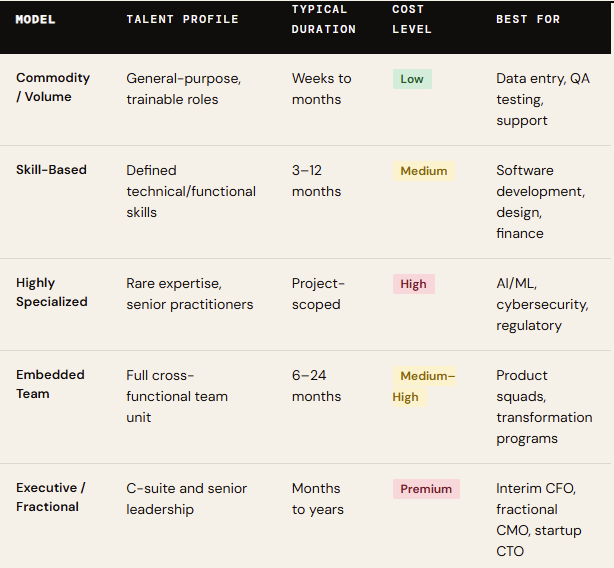
Most guides describe types of staff augmentation in three tiers — commodity, skill-based, and highly skilled. That framework is a starting point, but it misses important nuances. Here are the five staff augmentation models you need to understand when building a workforce strategy:
Staff Augmentation vs Outsourcing vs Permanent Hiring
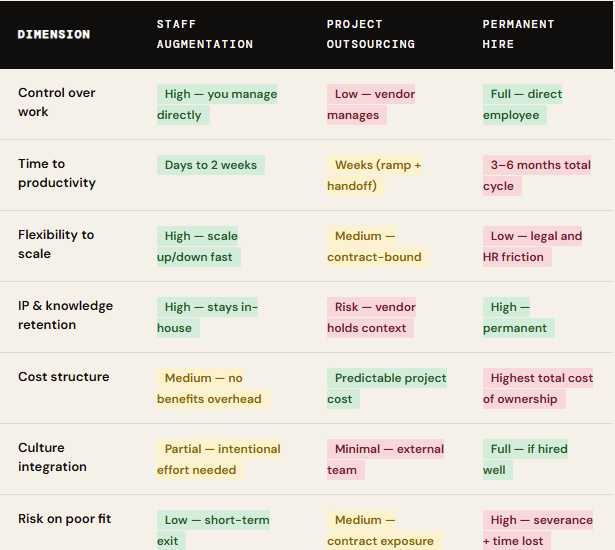
The staff augmentation vs outsourcing debate produces more heat than light. The honest answer is that they solve different problems — and confusing them leads to expensive mistakes. Here's a rigorous comparison across the dimensions that actually matter to leadership teams choosing between staff augmentation, managed services, and direct hiring:
How Staff Augmentation Works: 8-Step Implementation Guide
Staff augmentation fails most often not because the talent was wrong — but because the process was improvised. Here's a structured implementation framework based on how high-performing organizations actually deploy staff augmentation services successfully:
Conduct a Capability Gap Audit
Before engaging any staff augmentation company, map your internal capabilities against your strategic roadmap. Identify specific skill gaps — not just "we need more developers" but "we need senior engineers with React Native and fintech API integration experience." Precision here drives quality matching.
Define the Engagement Model & Exit Criteria
Decide upfront: is this a time-bound contract staffing arrangement, a project milestone engagement, or a "try-before-you-hire" arrangement? Knowing the exit criteria in advance shapes how you onboard, integrate, and manage the augmented workforce relationship.
Vet Staff Augmentation Partners — Not Just Talent
Your staff augmentation partner's vetting process is the single biggest predictor of outcome quality. Interrogate their screening methodology: How do they assess hard skills? Do they evaluate cultural fit? What's their replacement SLA if a placement doesn't work out?
Structure the Legal & Compliance Framework
Ensure NDAs, IP assignment clauses, data security agreements, and worker misclassification risk are addressed before day one. In many jurisdictions, augmented staff who work full-time, long-term can be reclassified as employees — with serious tax and legal consequences for your organization.
Design a Proper Onboarding Protocol
Augmented staff often receive zero onboarding — then underperform for weeks. Treat them like a new employee: system access, team introductions, product context, documentation of your processes, and a 30-day milestone plan. This is especially critical in remote staff augmentation arrangements.
Assign an Internal Champion
Every augmented professional needs a designated internal point of contact who can unblock issues, provide feedback, and translate company culture. This isn't the hiring manager — it's someone who'll be working alongside them daily and can bridge the gap between permanent and augmented team members.
Establish Clear Performance Metrics
Define what success looks like in measurable terms before the staff augmentation engagement starts. Velocity benchmarks, quality standards, deliverable milestones, or collaboration metrics — whatever matters for the role. Ambiguity on performance expectations is the leading cause of augmentation program failures.
Plan the Knowledge Transfer Exit
When the engagement ends, what happens to the knowledge the augmented staff member acquired? Build a formal knowledge transfer process — documentation, recorded walkthroughs, handoff sessions — into the staff augmentation contract, not as an afterthought.
Staff Augmentation Mistakes That Kill Programs
The failures aren't random — they cluster around predictable patterns. Here are the mistakes that derail staff augmentation programs most consistently, and what to do instead:
· Treating Augmented Staff as Outside Contractors
Augmented professionals who feel excluded disengage fast. Exclude them from all-hands meetings, Slack channels, and team rituals — and you'll get transactional work, not invested contribution. Workforce augmentation only works when people feel genuinely part of the team.
· Skipping Internal Readiness Assessment
Staff augmentation services amplify your existing processes — good or bad. If your internal workflows, documentation, and management practices are broken, adding augmented talent makes the chaos bigger, not smaller. Fix the foundation first.
· Choosing Staff Augmentation Partners on Price Alone
The lowest-cost staff augmentation company is almost never the lowest total cost of augmentation. Poor matches cost you in ramp time, rework, and replacement cycles. Evaluate on quality and fit, then negotiate on price.
· Ignoring Your Permanent Team's Psychology
Existing employees watch how augmented workers are treated — and draw conclusions about their own job security. If you bring in augmented talent without communicating the rationale, you risk morale damage and voluntary attrition among your best permanent staff.
IT Staff Augmentation & Industry-Specific Use Cases
Technology & Software Development
The most mature market for IT staff augmentation. Engineering teams augment for full-stack development, DevOps, cybersecurity, QA, and cloud architecture — often building "core + flex" organizations where a small permanent team owns architecture and strategy while augmented developers handle feature velocity. Technology staff augmentation is projected to be the fastest-growing segment through 2027.
Financial Services & Fintech
Regulatory complexity drives strong demand for augmented compliance specialists, risk analysts, and AML/KYC professionals. Banks and fintechs use staff augmentation services to navigate regulatory change programs without building permanent headcount for cyclical requirements that may not repeat.
Healthcare & Life Sciences
Clinical trial management, medical writing, regulatory affairs, and health informatics are all high-demand staff augmentation categories. The FDA approval cycle creates intense short-term talent needs that don't map to permanent hiring logic — making resource augmentation the natural solution.
E-Commerce & Retail
Seasonal demand spikes make workforce augmentation a natural fit. Beyond seasonal workers, e-commerce companies augment for growth marketing specialists, data analysts, and Shopify/Magento developers to accelerate platform capabilities — a use case where remote staff augmentation has become particularly widespread post-2020.
The Future of Staff Augmentation: AI, Remote Work & What's Next
The next evolution of staff augmentation isn't just about geography or cost — it's about the integration of AI-assisted talent into human workflows. Several converging trends are reshaping what staff augmentation services look like in 2026 and beyond:
AI-Assisted Talent Matching: Staff augmentation companies are deploying ML models that match talent to requirements at semantic depth — analyzing project context, team composition, communication styles, and technical stack to predict fit, not just match keywords on a resume.
Hybrid Human-AI Augmented Teams: Augmented professionals increasingly work alongside AI tools that amplify their output — a single augmented analyst with the right AI stack can now deliver what previously required a team of three, changing the cost calculus of workforce augmentation entirely.
Outcome-Based Staff Augmentation Contracts: The shift from time-and-materials to outcome-based pricing is accelerating. As measurement tools improve, staff augmentation engagements are increasingly tied to deliverable quality rather than hours worked — aligning incentives between clients and augmentation partners.
Staff Augmentation FAQ: Common Questions Answered
What is staff augmentation and how does it work?
Staff augmentation is a hiring strategy where companies bring in external professionals to work within their internal team on a temporary basis. It works by engaging a staff augmentation partner who provides pre-vetted talent to fill specific skill gaps. The augmented staff member integrates into your workflows, attends your team meetings, reports to your managers, and delivers work under your direction — without being a permanent employee on your payroll.
What is the difference between staff augmentation and outsourcing?
The core difference between staff augmentation vs outsourcing is control. With staff augmentation, you manage the talent directly — they work inside your team, follow your processes, and you own all decisions. With outsourcing, you hand a problem to an external vendor who manages their own team, processes, and delivery. Staff augmentation gives you more control and integration; outsourcing gives you less oversight but removes management burden entirely.
What are the main types of staff augmentation?
The five main types of staff augmentation are: (1) Commodity augmentation — general-purpose roles like data entry and QA; (2) Skill-based augmentation — defined technical roles like software development or financial analysis; (3) Highly specialized augmentation — rare expertise like AI/ML or cybersecurity; (4) Embedded team augmentation — full cross-functional product squads; and (5) Fractional/executive augmentation — interim C-suite and senior leadership roles.
What are the key benefits of staff augmentation?
The primary staff augmentation benefits include: faster access to specialized skills (3× faster than traditional hiring), significant cost savings (40–70% vs fully-loaded permanent employee costs), workforce flexibility to scale up or down quickly, reduced hiring risk through short-term evaluation before permanent offers, and maintained operational control vs outsourcing. For technology companies, IT staff augmentation specifically enables rapid capability expansion without long-term headcount commitments.
How fast can augmented staff get onboarded and start delivering?
For skill-based staff augmentation through a quality partner: 1–2 weeks for candidate identification, 3–5 days for legal and onboarding formalities, and 1–2 weeks for role-specific ramp. Plan for 3–4 weeks to full productivity for complex IT staff augmentation roles. Remote staff augmentation and offshore arrangements may add coordination time but typically still outpace permanent hiring by 2–3× on total time-to-productivity.

 Arabic
 French
 Spanish
 Portuguese
 Deutsch
 Turkish
 Dutch
Dutch
 Italiano
 Russian
 Romaian
 Portuguese (Brazil)
 Tiếng Việt