


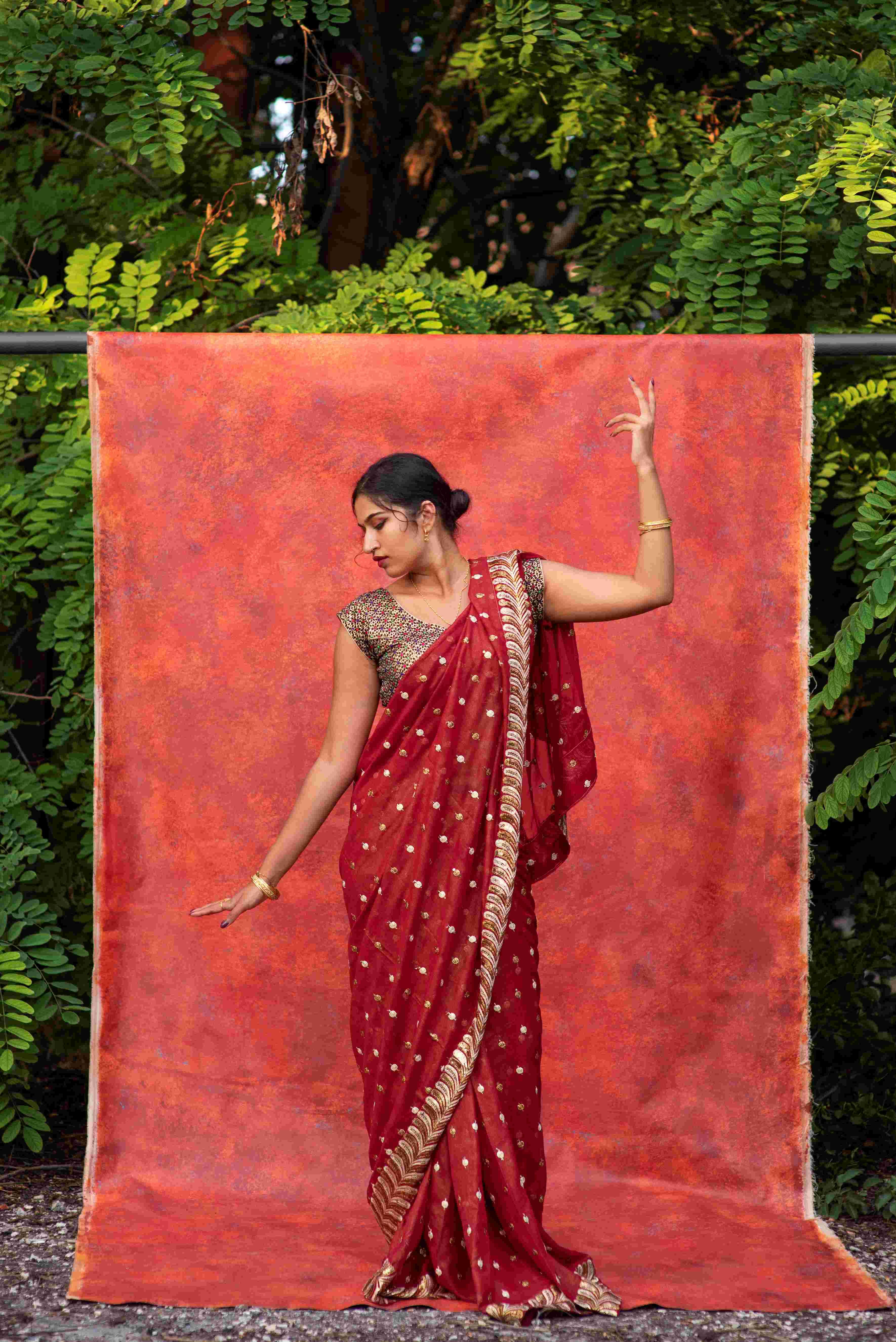
Among the most acknowledged treasures of Indian textile heritage, the Banarasi silk saree stands in a category entirely its own. Woven in the ancient holy city of Varanasi — also known as Banaras — these magnificent sarees have been prized by royalty, adorned by brides, and treasured across generations for over five centuries. A Banarasi silk saree is not merely a garment; it is a wearable masterpiece that embodies the extraordinary artistic traditions of Indian handloom weaving.
The distinctive characteristic of an authentic Banarasi silk saree lies in its weaving technique. Skilled weavers use pure silk threads interlaced with fine gold and silver zari to create intricate patterns inspired by Mughal art, Persian motifs, and Indian floral designs. The brocade patterns on a traditional Banarasi silk saree typically feature jaal designs — fine, interconnected lattice work — along with lotus flowers, kalga motifs, and elaborate butti patterns scattered across the fabric. The zari work gleams magnificently, creating a garment that seems to radiate its own inner light.
There are several distinct varieties of the Banarasi silk saree , each with its own unique character and aesthetic. Katan silk sarees feature the finest pure silk and are known for their incredible luster and smooth texture. Organza Banarasi sarees are lighter and more translucent, featuring delicate weaving perfect for warmer traditional events. Georgette Banarasi sarees combine the luxury of Banarasi weaving with the graceful drape of georgette fabric. Shattir sarees feature extra silk threads that create a unique textural richness.
The color palette of a Banarasi silk saree is as rich and diverse as Indian cultural tradition itself. Classic combinations like red and gold, deep green and silver, royal blue and gold, and ivory and gold remain eternally popular for traditional ceremonies and weddings. Contemporary weavers have expanded the color vocabulary to include pastels, jewel tones, and even gradient-dyed fabrics, ensuring the Banarasi silk saree remains relevant and desirable to modern fashion sensibilities while honoring its traditional roots.
Traditional events and ceremonies across India are fundamentally incomplete without the presence of the Banarasi silk saree . From wedding ceremonies to engagement rituals, from Puja celebrations to festive occasions like Dussehra and Diwali, this magnificent saree graces the most significant moments of Indian cultural life. Many families pass down Banarasi sarees as precious heirlooms, with grandmothers gifting their treasured pieces to granddaughters, creating tangible threads of family continuity and cultural memory.
Draping a Banarasi silk saree requires skill and attention to the fabric's weight and drape. The Nivi drape — the most common style across India — works beautifully with Banarasi silk, allowing the intricate pallu to be displayed over the shoulder in all its embroidered glory. The Gujarati seedha pallu style, where the pallu is draped in front, is another elegant option that fully showcases the weaving on the saree's border and end piece. Professional saree draping services are increasingly popular for events where the perfect presentation is paramount.
Jewelry choices for a Banarasi silk saree ensemble require careful consideration. Heavy gold jewelry — temple jewelry sets, kundan necklaces, polki earrings — pairs magnificently with the richness of the zari work. Traditional jewelry traditions from across India find their perfect complement in the Banarasi silk saree : Jadau jewelry from Rajasthan, temple jewelry from South India, and traditional Bengali gold pieces all harmonize beautifully with these magnificent woven treasures. The combination of ancestral jewelry and a quality Banarasi saree creates a look of profound traditional elegance.
Caring for a Banarasi silk saree properly is essential to preserve its beauty across decades and generations. Dry cleaning is always recommended for heavily embroidered pieces, as the delicate zari threads can be damaged by water. Proper storage in breathable muslin cloth, away from plastic bags that can trap moisture and cause yellowing, ensures the fabric retains its luster. Periodic airing and gentle folding along different lines prevents permanent crease marks. With proper care, a quality Banarasi silk saree can maintain its magnificence for a century or more.
The Banarasi weaving industry faces significant challenges in the modern era, with handloom production competing against power-loom reproductions. Authentic handwoven Banarasi silk sarees are distinguished by their heaviest weight, more intricate patterns, slight irregularities that evidence human craftsmanship, and silver or gold purity in the zari threads. Supporting authentic handloom Banarasi weavers is not only a fashion choice but an act of cultural preservation, ensuring these extraordinary artistic traditions survive for future generations.
In conclusion, the Banarasi silk saree represents the absolute pinnacle of Indian textile artistry. Its combination of sumptuous silk, intricate zari weaving, and centuries of cultural heritage makes it an irreplaceable treasure in every Indian woman's wardrobe. Wearing a Banarasi silk saree to a traditional event is an act of cultural pride, aesthetic celebration, and connection to the timeless beauty that defines Indian civilization. These magnificent sarees deserve to be celebrated, preserved, and cherished as the national heritage they truly are.

 English
 Arabic
 French
 Spanish
 Portuguese
 Deutsch
 Turkish
 Dutch
Dutch
 Italiano
 Russian
 Romaian
 Portuguese (Brazil)