


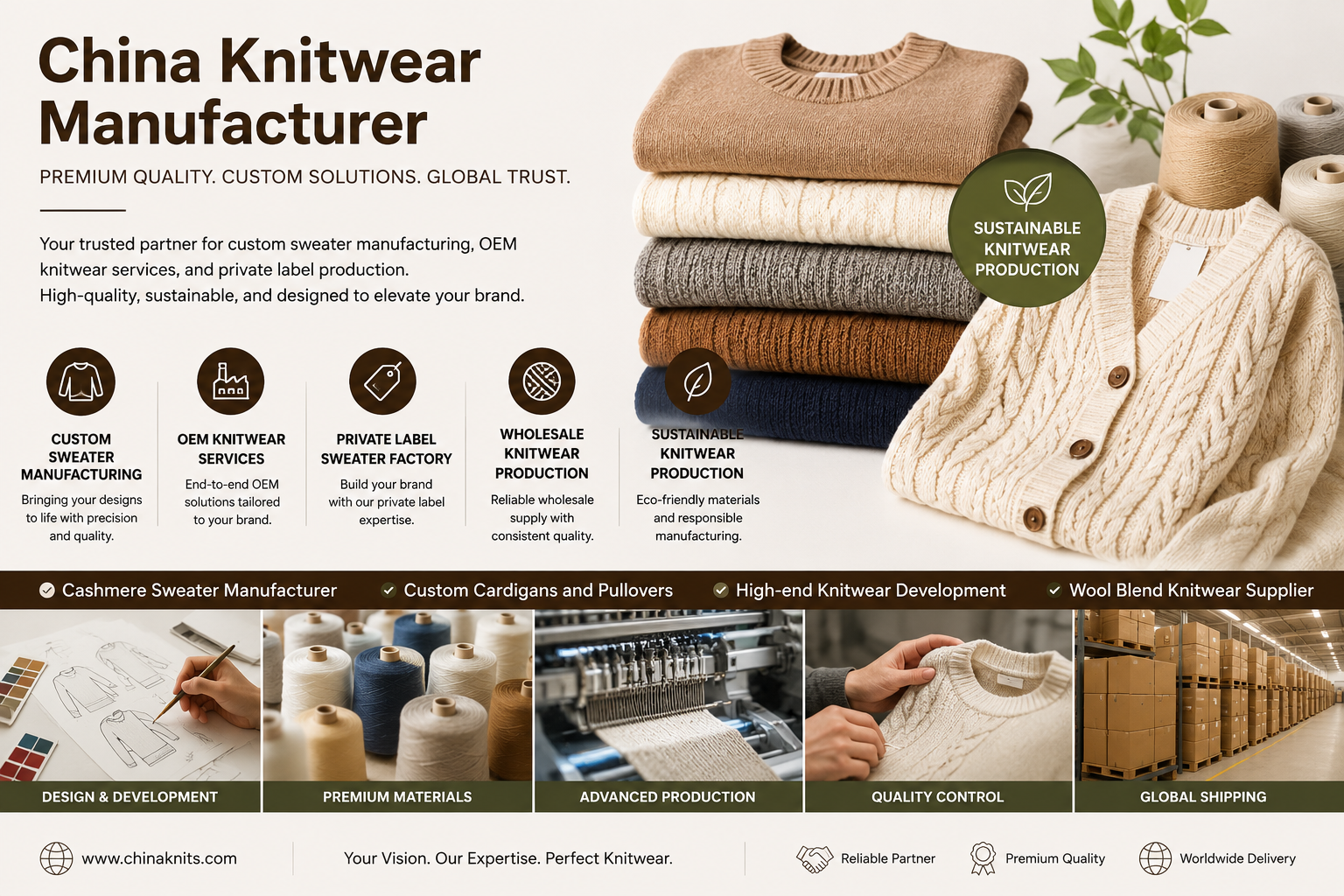
You have the design vision. You know the silhouette, the yarn weight, the color story. What you need now is the right manufacturing partner to turn that vision into a finished product that your customers will love — and that your brand can be proud of.
That is exactly what custom sweater manufacturing is all about.
Whether you are launching your first knitwear collection, scaling an existing line, or developing a private label range for retail, custom sweater production gives you complete control over every element of the finished garment — from fiber composition and construction technique to finishing details and packaging. But navigating the manufacturing process successfully requires understanding how it works, what decisions matter most, and where things typically go wrong.
This guide covers everything you need to know — clearly, practically, and without the jargon.
What Is Custom Sweater Manufacturing?
Custom sweater manufacturing is the process of producing knitted garments built entirely to your specifications — your design, your yarn, your measurements, your branding. Unlike buying off-the-shelf wholesale sweaters and adding a label, true custom production means every element of the garment is developed specifically for your brand.
In practice, this covers a broad spectrum of engagement models. On one end, you supply a complete tech pack — detailed construction specifications, yarn call-outs, measurement charts, and stitch diagrams — and the factory executes your design precisely. On the other end, you work collaboratively with the factory's design and development team, starting from a mood board or a reference sample and building the final specification together through an iterative sampling process.
Both approaches are valid. The right one for your brand depends on your in-house design capability, your timeline, and how much creative input you want from your manufacturing partner. The best custom sweater manufacturers are equally comfortable with both — and can guide you toward the approach that suits your specific situation.
Why Custom Manufacturing Beats Off-the-Shelf Every Time
Many brands start out buying generic wholesale knitwear and customizing it with their own labels. It is a low-risk way to test the market, and for some brands at very early stages, it makes sense. But the limitations of that approach become apparent quickly — and when they do, custom sweater manufacturing is always the answer.
Your Product Becomes Genuinely Distinctive
When every brand in your market segment is pulling from the same pool of wholesale stock, the products inevitably start to look similar. Custom manufacturing breaks that cycle. Your yarn composition, your gauge selection, your stitch detail, your proportions, your color palette — none of these are available to your competitors because they were developed specifically for you.
That distinctiveness is not just an aesthetic advantage. It is a commercial one. Customers who cannot find your exact product anywhere else have only one place to buy it — from you.
You Control Quality From the Ground Up
With off-the-shelf product, you inherit whatever quality decisions the original manufacturer made — yarn grade, tension consistency, seam construction, finishing standard. With custom manufacturing, you define those standards yourself. You specify the yarn. You approve the gauge swatch. You check the pre-production sample. You set the measurement tolerance. Quality becomes something you build into the product rather than something you hope for after the fact.
Margins Improve as Volume Grows
Custom manufacturing relationships reward commitment. As your order volumes grow and your relationship with your factory deepens, unit costs decrease, lead times shorten, and your factory's investment in understanding your brand's standards pays dividends in production consistency. Over time, a well-managed custom manufacturing relationship becomes one of your brand's most valuable operational assets.
The Custom Sweater Development Process: Step by Step
Understanding the development sequence helps you plan your timeline realistically and avoid the most common sourcing mistakes.
Step 1 — Design Brief and Yarn Selection
Every custom sweater starts with a brief. At minimum, your brief should communicate the garment's intended end use, target market, price point, fiber preferences, and any specific construction requirements or design features you have in mind.
Yarn selection happens in parallel with or immediately after the brief. This is one of the most consequential decisions in the entire development process. Yarn determines how the finished garment feels against the skin, how it drapes on the body, how it performs after washing, and how it is perceived by the end consumer. A beautiful design in the wrong yarn produces a disappointing garment. A simple design in an exceptional yarn produces something genuinely special.
The most capable custom sweater manufacturing partners will guide you through yarn selection with samples, swatches, and practical advice — drawing on their relationships with premium yarn mills to match your quality requirements to your cost targets.
Step 2 — Gauge and Construction Specification
Gauge — expressed in GG (gauge per inch) — determines the scale and texture of the knitted fabric. Lower gauges (3GG, 5GG, 7GG) produce chunky, open-stitch fabrics with pronounced texture and significant weight. Higher gauges (12GG, 14GG, 16GG) produce fine, smooth fabrics closer to woven in hand and drape.
Choosing the right gauge for your design is a technical decision with significant implications for both aesthetics and price. Higher-gauge production requires finer, more expensive yarns and slower machine speeds — both of which increase cost per unit. Lower-gauge production is faster but not suitable for designs requiring fine detail or smooth surface texture. An experienced factory will help you find the gauge that best serves your design intent within your cost parameters.
Construction technique is equally important. Flat knitting on computerized machines allows for full-fashioned shaping — where the garment panels are shaped directly on the machine rather than cut from flat fabric. This technique produces cleaner seams, less material waste, and a superior fit. More complex decorative techniques — intarsia for color-block designs, jacquard for all-over patterns, cable knitting for textural surface interest, pointelle for openwork detail — each have specific machine and skill requirements that not every factory can meet.
Step 3 — Sampling
Sampling is where the design becomes a physical garment for the first time — and it is the most important quality control stage in the entire development process.
A first sample — sometimes called a proto or development sample — is produced to confirm that the construction concept works as intended. It may not be in the final yarn or the final colorway, but it should demonstrate the key construction features and overall proportions of the design.
After review and any necessary adjustments, a salesman sample or pre-production sample is produced in the final specified yarn, color, and size. This is the sample against which bulk production will be measured. It needs to be right before bulk is confirmed — because whatever issues exist in the pre-production sample will exist throughout the bulk run.
Never skip or rush the sampling stage. It is the single most effective quality protection available to you in the entire manufacturing process.
Step 4 — Bulk Production
Once the pre-production sample is approved, bulk production begins. A well-organized factory will conduct in-line quality checks throughout production — checking gauge consistency, construction quality, measurement compliance, and color accuracy at regular intervals rather than waiting until the full run is complete to inspect finished goods.
For international buyers who cannot be physically present during production, requesting in-production photos and reports at key milestones — cut panels, linked garments before washing, finished goods before packing — provides meaningful visibility into production progress and quality without requiring travel.
Step 5 — Final Inspection and Shipment
Final inspection before packing and shipment is the last opportunity to identify and address quality issues before goods leave the factory. A formal AQL (Acceptable Quality Level) inspection — either conducted by the factory's own QC team, an independent third-party inspection agency, or both — checks finished garments against your approved pre-production sample for measurements, construction quality, appearance, and labeling compliance.
Investing in independent final inspection for significant orders is one of the most cost-effective quality protection measures available. The cost of inspection is always less than the cost of receiving a shipment of substandard goods that cannot be sold.
Key Factors That Determine Custom Sweater Manufacturing Quality
Yarn Quality and Consistency
The single biggest determinant of finished garment quality is yarn. A factory that sources yarn carefully — verifying fiber content, twist consistency, color fastness, and lot-to-lot consistency — produces dramatically more consistent results than one that optimizes purely for yarn price. When evaluating potential manufacturing partners, ask directly about their yarn sourcing process and request yarn test certificates for the fibers specified in your product.
Machine Capability and Maintenance
Modern computerized flat knitting machines from leading manufacturers produce exceptional results — but only when properly maintained and operated by skilled technicians. Factories that invest in machine maintenance, operator training, and regular technical upgrades consistently produce higher-quality output than those that run aging equipment without adequate upkeep. A factory visit — or at minimum, detailed photos of the production floor and equipment — gives you meaningful insight into this aspect of manufacturing capability.
Finishing Standards
Finishing — the processes applied to knitted panels and assembled garments after knitting — has an enormous impact on the final product's appearance, hand feel, and dimensional stability. Washing, steaming, blocking, and pressing all contribute to how the finished garment looks and feels. Factories that invest in professional finishing equipment and skilled finishing operators produce garments that feel premium and photograph beautifully. Factories that treat finishing as an afterthought produce garments that look exactly like that.
China: The Global Center of Custom Sweater Manufacturing Excellence
When global fashion brands — from fast fashion giants to independent luxury labels — need custom knitwear manufactured to exacting standards at commercially viable prices, they overwhelmingly turn to China. The reasons are structural and deeply embedded in how China's knitwear industry has developed over the past four decades.
The production clusters in Puyuan, Zhejiang and Dongguan, Guangdong bring together thousands of specialized knitwear factories, yarn suppliers, trim manufacturers, and finishing specialists within concentrated geographic areas. This ecosystem enables the kind of rapid, flexible product development that modern fashion brands require — sampling in days rather than weeks, adjustments made quickly, and bulk production managed with genuine attention to the standards international buyers expect.
Furthermore, Chinese custom sweater manufacturers have accumulated decades of experience working with demanding international buyers across every market segment — luxury, contemporary, commercial, and fast fashion. That accumulated experience translates into factories that understand what international brands need, communicate effectively in English, and manage the documentation, compliance, and logistical requirements of international trade competently.
For brands serious about building a knitwear business on a foundation of genuine manufacturing excellence, partnering with ChinaKnits connects you with a manufacturing partner that brings exactly this depth of experience and international orientation to every project — combining technical knitwear expertise with the service standards that global brands require.
Common Mistakes in Custom Sweater Sourcing — and How to Avoid Them
Choosing a factory based on price alone. The lowest quote rarely delivers the best value. A factory quoting significantly below market rate is almost always cutting corners somewhere — on yarn quality, on sampling investment, on finishing standards, or on production oversight. Evaluate capability first, then negotiate pricing from a position of informed judgment.
Providing incomplete technical documentation. Vague briefs produce vague results. The more precisely and completely you communicate your requirements, the more accurately the factory can produce what you actually want. A complete tech pack — with detailed measurements, construction notes, yarn specifications, and annotated reference imagery — is an investment that pays for itself in reduced sampling rounds and fewer bulk production issues.
Skipping the pre-production sample approval. Approving bulk production without a fully confirmed pre-production sample in final materials is one of the most common and costly mistakes in knitwear sourcing. The pre-production sample is your last opportunity to identify and correct issues before they exist in thousands of garments.
Underestimating lead times. Custom sweater manufacturing takes time — typically 45 to 90 days from order confirmation to shipment for a standard bulk run, depending on factory capacity and order complexity. Planning your production calendar with realistic lead times built in, rather than optimistic ones, is the single most effective way to avoid the cost and stress of late deliveries.
Conclusion
Custom sweater manufacturing is one of the most powerful tools available to fashion brands that want to compete on product quality and distinctiveness rather than simply on price. When executed well — with the right factory, the right development process, and the right quality standards in place — it gives your brand a knitwear offering that is genuinely yours in every respect.
The key is finding a manufacturing partner with the technical capability, communication quality, and commitment to service that your brand's ambitions deserve. China's knitwear manufacturing industry offers exactly that — for brands willing to invest the time in building the right relationships and approaching the process with the diligence it requires.
For brands ready to take their knitwear seriously, working with a dedicated custom sweater manufacturing partner is where that journey begins. To explore what experienced, internationally focused knitwear production looks like in practice, visit the website and take the first step toward a manufacturing relationship built on craft, consistency, and genuine expertise.

 English
 Arabic
 French
 Spanish
 Portuguese
 Deutsch
 Turkish
 Dutch
Dutch
 Italiano
 Russian
 Romaian
 Portuguese (Brazil)