


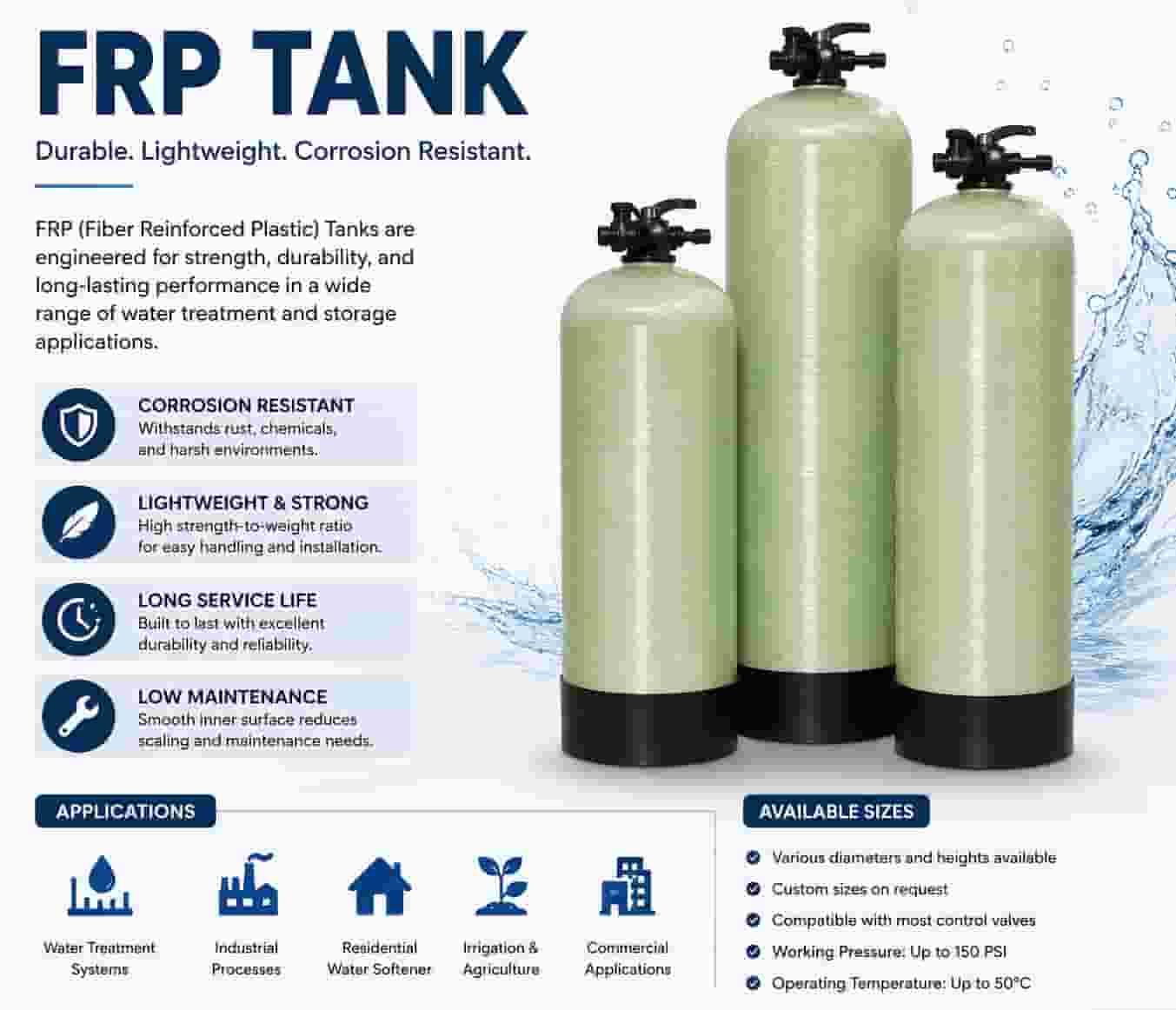
What Is an FRP Tank and Why Does Your Water System Need One?
If you are planning a water treatment system, the tank is one of the most important decisions you will make. The wrong tank corrodes, leaks, and fails early. The right tank runs quietly in the background for 20 years without demanding attention.
An FRP tank is that right tank for most water treatment applications. Fiberglass reinforced plastic has become the industry standard for water softeners, sand filters, carbon filters, and RO pre-treatment systems worldwide. This guide explains exactly what makes FRP tanks different, where they are used, and how to choose the correct one for your system.
What Does FRP Stand For?
FRP stands for fiberglass reinforced plastic. It is a composite material. Glass fiber strands are combined with a polymer resin to create a material that is strong, lightweight, and chemically resistant.
The manufacturing process matters. Quality FRP tanks are made using a computer-controlled CNC winding machine. Glass fibers are wound around a mandrel in a precise three-dimensional pattern. This creates uniform wall thickness across the entire vessel. There are no weak spots from welding seams. The result is a pressure vessel with consistent structural integrity throughout.
Most quality fiberglass tanks also include a polyethylene (PE) inner liner. This liner sits between the water and the fiberglass wall. It prevents chemical interaction. It also makes the interior surface smooth for easy media loading and cleaning.
How Is an FRP Tank Different From a Steel or Plastic Tank?
This question comes up every time someone starts designing a water treatment system. Steel tanks are cheaper upfront. Plastic tanks are the lightest option. So why choose FRP?
The answer is simple: long-term performance and total cost of ownership.
Steel Tanks Corrode
Steel reacts with water, minerals, and treatment chemicals. Rust forms on internal surfaces. This contaminates stored water and weakens the tank wall. In saltwater and brine applications, steel deteriorates rapidly. Relining or replacement becomes necessary within 8–12 years in most water treatment environments.
An FRP tank does not rust. The glass fiber and resin matrix is chemically inert. It does not react with brine, chlorinated water, or the acids and alkalis used in regeneration cycles. This is why fiberglass has replaced steel in virtually every modern water treatment plant.
Plastic Tanks Cannot Handle Pressure
Standard plastic tanks are lightweight and inexpensive. However, they are not pressure vessels. They cannot handle the operating pressures of a water softener or sand filter system. Most residential water treatment systems operate at 60–100 PSI. Standard plastic tanks fail at these pressures.
FRP tanks are engineered pressure vessels. Standard models handle 150 PSI consistently. The three-dimensional fiber winding distributes pressure stress evenly across the vessel wall. This gives FRP tanks a safety factor of roughly 3x their rated operating pressure.
The Cost Comparison Over Time
Steel needs relining or replacement every 8–12 years in water treatment environments. Plastic needs replacement every 10–15 years. A quality FRP water tank lasts 20–30 years with minimal maintenance. Over a 20-year period, FRP almost always costs less than steel despite the higher purchase price.
Where Are FRP Tanks Used?
FRP tanks and fiberglass water tanks are used across a wide range of water treatment applications. Understanding these applications helps you identify which configuration you need.
Water Softener Pressure Vessels
A water softener holds ion exchange resin inside an FRP pressure vessel. Hard water enters the top of the tank and passes through the resin bed. Calcium and magnesium ions are captured. Softened water exits at the bottom.
The tank is then regenerated using brine solution. Brine is highly corrosive to steel. It does not affect FRP at all. This is why every serious water softener manufacturer uses FRP pressure vessels. Our range of FRP tanks includes all standard sizes for residential and commercial softener applications.
Sand and Multi-Media Filter Vessels
Multi-media filtration removes sediment, turbidity, and suspended particles from raw water. The filter media — typically quartz sand, anthracite, and garnet — sits inside an FRP pressure vessel. Water flows down through the media bed and exits filtered at the bottom.
The vessel must handle regular backwash cycles. During backwash, water flows upward through the media at high velocity. This requires a tank that can handle rapid pressure and flow changes without flexing or cracking. FRP handles these demands without stress.
Carbon Filter Vessels
Activated carbon filtration removes chlorine, chloramines, volatile organic compounds, and chemical taste and odor from water. The carbon media sits inside an FRP pressure vessel. As water passes through, contaminants adsorb onto the carbon surface.
Carbon filter vessels are common in both residential and industrial water treatment. They protect downstream RO membranes from chlorine damage. Our dedicated FRP water treatment tanks range covers all standard carbon filter configurations.
RO Pre-Treatment Systems
Reverse osmosis membranes are sensitive and expensive. They need clean, pre-treated feed water to function properly. Sand filter and carbon filter FRP vessels form the pre-treatment train that protects the membrane.
This pre-treatment stage removes sediment that would physically damage the membrane surface. It also removes chlorine that degrades the thin-film composite membrane material. Without proper FRP pre-treatment vessels upstream, RO membranes foul and fail prematurely.
Industrial and Municipal Water Treatment
Large water treatment plants use FRP tanks in arrays. Multiple vessels operate in parallel to handle high daily flow rates. Municipal softening systems, industrial process water plants, and commercial RO systems all rely on FRP pressure vessels as their core treatment components.
The lightweight nature of FRP simplifies installation in multi-story treatment plant buildings. Floor load limits are a real concern in industrial buildings. An FRP vessel weighing 30–50% less than equivalent steel makes this much easier to manage.
FRP Tank Size Guide
FRP tanks use a model numbering system based on dimensions. Understanding this system helps you select the correct size.
The model number reflects diameter and height in inches:
- 817 = 8-inch diameter, 17-inch height
- 1054 = 10-inch diameter, 54-inch height
- 1465 = 14-inch diameter, 65-inch height
- 2472 = 24-inch diameter, 72-inch height
- 3672 = 36-inch diameter, 72-inch height
Smaller models (817 to 1265) suit residential applications. Medium models (1354 to 2069) handle commercial systems. Large models (2472 and above) are for industrial and municipal use.
Opening size also varies by model. Small tanks use 2.5-inch top openings. Medium tanks use 4-inch openings. Large industrial tanks use 4-inch or 6-inch flanged openings. Opening size affects media loading, distributor selection, and control valve compatibility.
Always size your tank to your system flow rate. An undersized vessel creates excessive pressure drop. An oversized vessel reduces filtration contact time. Both scenarios reduce system performance. Our FRP vessels for water treatment product range includes detailed sizing charts to help you match vessels to your flow requirements.
FRP Tank Specifications: What to Check Before Buying
Before ordering any FRP storage tank, confirm these key specifications.
Pressure rating. Standard models are rated to 150 PSI. Confirm your system's maximum operating pressure does not exceed this. If it does, order a higher-rated vessel.
Opening size. Match the top opening to your control valve and distributor. A mismatched opening prevents proper installation.
Liner material. A food-grade PE inner liner is essential for potable water applications. Confirm liner specifications if your application involves drinking water.
Burst pressure. Quality FRP tanks have a burst pressure rating of at least 3x their operating pressure. This is the safety factor. Confirm it meets or exceeds your application requirements.
Operating temperature range. Standard FRP tanks handle 1–49°C (34–120°F). High-temperature applications may require specialist vessels.
Certifications. For drinking water applications, look for NSF/ANSI 61 certification on the PE liner material.
FRP Tank Installation: Step by Step
Installing an FRP tank correctly takes less time than most people expect. Follow these steps for a clean, leak-free installation.
Step 1 — Prepare the site. The base must be level and stable. A concrete pad is recommended for larger vessels. Soft or uneven ground causes tanks to settle and stress the pipe connections.
Step 2 — Position the tank. Place the tank in its final location before connecting any pipework. FRP tanks are light enough to move by hand in most residential sizes. Large industrial models may require mechanical assistance.
Step 3 — Install the distributor. Insert the distributor tube into the tank through the top opening. The distributor sits at the bottom of the tank and controls water flow through the media bed.
Step 4 — Load the media. Fill the tank with the correct media type and quantity for your application. Use a funnel to avoid spilling media around the top opening. Follow manufacturer guidelines for fill levels.
Step 5 — Install the control valve. Thread the control valve onto the top opening. Apply Teflon tape to the threads first. Hand-tighten, then use a wrench for a quarter turn. Do not overtighten. FRP threads are strong but can crack under excessive force.
Step 6 — Connect inlet and outlet pipes. Connect your system pipework to the control valve ports. Use appropriate fittings rated for your operating pressure.
Step 7 — Commission the system. Fill the tank slowly and check all connections for leaks. Run a complete backwash cycle before putting the vessel into service. This settles the media bed and removes fines from new media.
FRP Tank Maintenance
FRP tanks require very little maintenance compared to steel alternatives. However, basic checks extend service life and prevent problems.
Inspect the exterior annually. Look for cracks, impact marks, or UV degradation on the outer surface. Outdoor tanks should be UV-stabilized or shielded from direct sunlight.
Check seals and O-rings every six months. These degrade over time. Replace them before leaks develop rather than after.
Monitor operating pressure. A sudden pressure drop indicates a clogged media bed or a distributor problem. A pressure spike indicates a downstream blockage. Both need investigation promptly.
Inspect the interior during media changes. Check the distributor screen for cracks or blockages. A damaged screen allows media to enter the treated water supply.
Common Mistakes When Buying FRP Tanks
Choosing based on price alone. The cheapest FRP tank is rarely the best value. Thin walls, poor PE liners, and substandard resin formulations reduce service life. Always check specifications before ordering.
Wrong opening size. A 2.5-inch opening on a large vessel makes media replacement extremely slow and difficult. Match opening size to your maintenance requirements from the start.
Ignoring pressure ratings. Never install a standard 150 PSI tank in a system with pressure spikes above that level. A pressure regulator upstream is essential protection.
Skipping the initial backwash. New filter media contains fines. These cloud the treated water supply if not removed first. Always run a full backwash cycle before commissioning.
Not matching tank size to flow rate. This is the most common sizing mistake. Always calculate your peak GPM requirement before selecting a model.
For complete product specifications and sizing information, browse our full FRP tanks product range. Each product page includes dimensional drawings, pressure ratings, flow specifications, and compatible accessories.
Frequently Asked Questions
Q: How long does an FRP tank last?
A: Quality FRP tanks last 20–30 years with proper maintenance. Corrosion is the main cause of early failure in steel tanks. FRP does not corrode, which is why its service life is significantly longer.
Q: Can FRP tanks be used for drinking water?
A: Yes. FRP tanks with food-grade PE inner liners are safe for potable water contact. Confirm NSF/ANSI 61 certification for drinking water applications before purchasing.
Q: What is the pressure rating of a standard FRP tank?
A: Standard residential and commercial FRP tanks are rated to 150 PSI. Industrial models with higher ratings are available. Always confirm the rating before installation.
Q: Can FRP tanks be used outdoors?
A: Yes. However, prolonged direct UV exposure degrades the outer resin layer over time. UV-stabilized models or protective coatings are recommended for permanent outdoor installations.
Conclusion
An FRP tank is not just a water storage container. It is a precision-engineered pressure vessel that forms the core of every serious water treatment system. Its corrosion resistance, pressure performance, light weight, and long service life make it the clear choice over steel, concrete, and plastic alternatives for water treatment applications.
Whether you need a compact vessel for a home water softener or a large fiberglass water tank for an industrial treatment plant, FRP delivers consistent, reliable performance for decades. Choose the right size, confirm the pressure rating, install correctly, and maintain regularly. Your FRP storage tank will repay that investment many times over throughout its service life.

 English
 Arabic
 French
 Spanish
 Portuguese
 Turkish
 Dutch
Dutch
 Italiano
 Russian
 Romaian
 Portuguese (Brazil)
 Tiếng Việt