


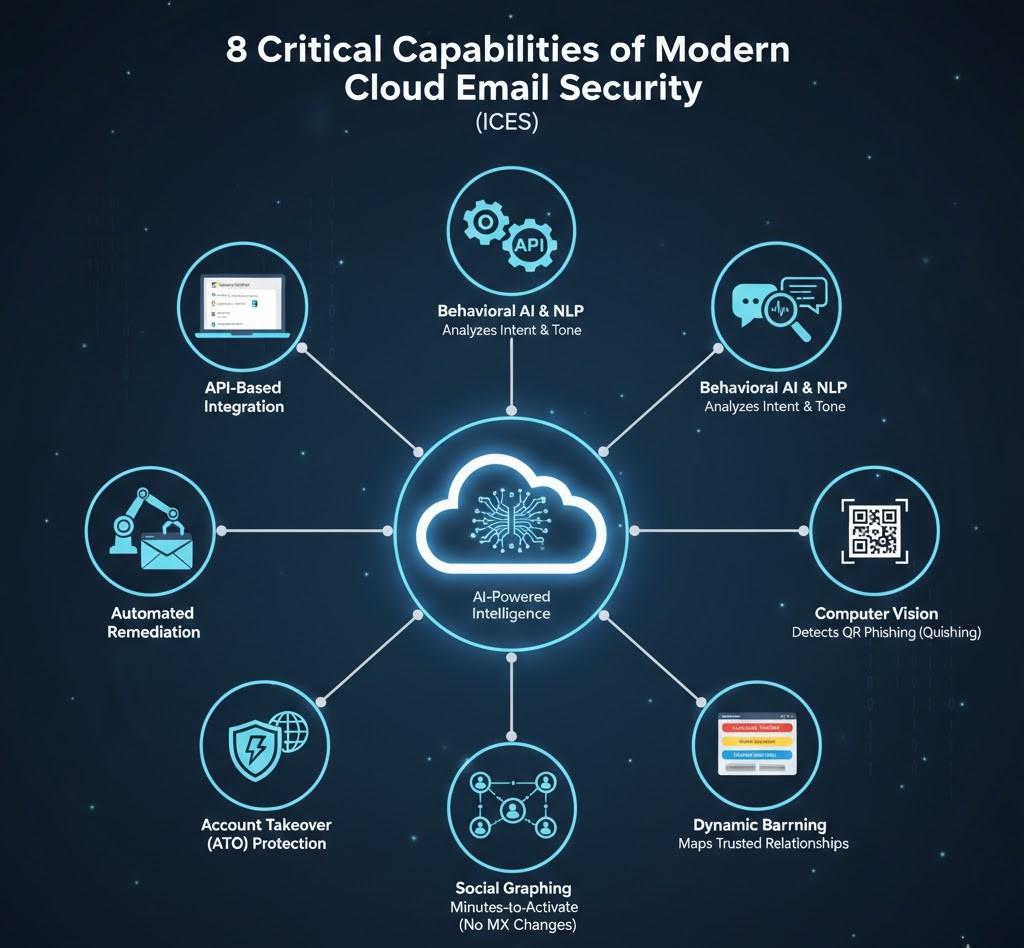
As we navigate the threat landscape of 2026, the legacy “Secure Email Gateway” (SEG) has officially become a relic of the past. Today’s threats are cloud-native, AI-driven, and socially engineered. To protect your organization, modern Email Security Solutions Dubai must adopt an Integrated Cloud Email Security (ICES) approach that moves far beyond simple filtering.
Here are the eight critical capabilities your modern email security stack must possess:
1. API-Based Integration
Modern security must live inside the mailbox environment (Microsoft 365 or Google Workspace), not just at the perimeter. API integration allows the system to see internal-to-internal emails and historical data, which traditional gateways miss.
2. Behavioral AI and NLP
With LLMs writing "perfect" phishing emails, looking for typos is useless. Modern tools use Natural Language Processing (NLP) to analyze the "DNA" of an email—detecting subtle anomalies in tone, urgency, and request patterns that signal a Business Email Compromise (BEC) attack.
3. Automated Remediation (The "Clawback")
If a threat is identified after delivery, your system shouldn't wait for a human admin. Critical solutions offer automated clawback, instantly removing a malicious email from every affected inbox across the entire organization the moment it is detected.
4. Computer Vision for "Quishing"
QR code phishing (Quishing) is a 2026 favorite for hackers. Modern security must "see" like a human, using Computer Vision to scan QR codes and images for hidden malicious URLs that text-based filters ignore.
5. Account Takeover (ATO) Protection
Threats often come from within trusted accounts. By monitoring login locations, MFA patterns, and mailbox rule changes (like "auto-forwarding"), modern security identifies when a legitimate user’s identity has been hijacked.
6. Social Graphing
This capability maps the relationship between your employees and their frequent contacts. If an email arrives from a "known" contact but the communication style or metadata doesn't match the historical Social Graph, it is flagged for review.
7. Dynamic Banner Warnings
Static "External Email" banners are ignored by users. Modern ICES uses Dynamic Banners that change color and messaging based on the specific risk level (e.g., "This sender has never emailed you before" or "This name matches an executive but the address is different").
8. Rapid Deployment and No MX Record Changes
In 2026, you shouldn't have to reroute your mail flow. Modern solutions deploy in minutes via API, ensuring there is no downtime or "point of failure" in your email delivery.
Conclusion
Email security is no longer about blocking "bad files"; it’s about authenticating identity and intent. If your current solution lacks these eight pillars, you aren't just at risk—you're already behind.

 Arabic
 French
 Spanish
 Portuguese
 Deutsch
 Turkish
 Dutch
Dutch
 Italiano
 Russian
 Romaian
 Portuguese (Brazil)
 Tiếng Việt